

Relationship
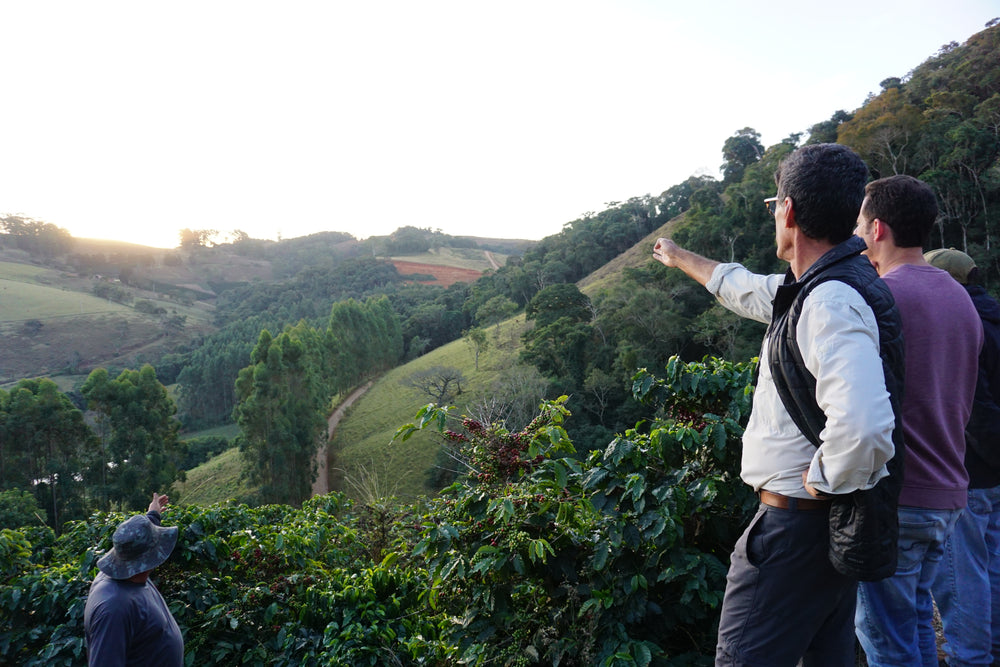
We have worked with Felipe and FAF Coffees every year since we opened our US roastery, and the relationship has only gotten stronger. FAF operates both as a farm and as an exporter supporting other Brazilian producers, which gives Felipe a depth of knowledge across the Mogiana region that consistently shows up in sample quality and lot selection. Four years in, we know what to expect from this table and it has not disappointed.
Country
Coffee arrived in Brazil in 1727, when Francisco de Melo Palheta, a Portuguese military officer sent to arbitrate a border dispute in French Guiana, smuggled coffee seeds back to Brazil, allegedly concealed in a bouquet of flowers by the governor's wife. Those first plants were cultivated in the northern state of Pará, and within a century Brazil had become the dominant force in global coffee production. By 1820 the country was producing 30 percent of the world's supply, and by the early 20th century that figure had climbed to 80 percent. It has remained the world's largest coffee producer ever since.
The scale of Brazilian production is defined by large mechanized estates built for efficiency, but the picture is more nuanced than that framing suggests. About half of Brazil's coffee producers are family-run farms under 10 hectares with minimal mechanization, relying on quality and cooperative representation to access markets. These smaller farms, known locally as sitios, are where much of the country's most interesting specialty work is happening. A growing movement of producers is separating individual farm lots rather than delivering to collectors, and the premiums that follow have created real momentum in the specialty segment.
Brazil is also where much of the coffee world's variety research has originated. Caturra, a dwarf mutation of Bourbon, was first found in Brazil. Mundo Novo, a Bourbon-Typica hybrid and parent of Catuai, was developed by Brazilian agricultural scientists. Catucai and Arara, two of the varieties we are featuring this season, are both Brazilian-bred cultivars developed through programs aimed at improving cup quality alongside disease resistance and yield. That combination of scale, smallholder diversity, and ongoing varietal innovation is why Brazil remains essential on our menu year after year.
(Sources: Sucafina, Cafe Imports, Royal Coffee)
Region – Mogiana
Mogiana is one of the oldest coffee-growing regions in Brazil, with cultivation history dating to the 1800s. The region takes its name from the Companhia Mogiana, the railway company whose lines traversed the mountainous coffee-producing interior of São Paulo state. That railway, known locally as the Coffee Train, was the infrastructure that made early production and exportation viable and shaped the region's identity around coffee from the outset.
The region runs along the border between São Paulo and Minas Gerais, with altitudes ranging from 900 to 1,400 meters above sea level depending on location. Temperatures are mild and consistent, averaging around 20°C, with well-defined wet and dry seasons. Rain falls mostly between October and March, while the dry harvest season runs from April through September, creating conditions that support thorough and even drying. The combination of altitude, stable temperatures, and seasonal rhythm slows cherry maturation and builds the sweetness and balance that Mogiana is known for. Lots from the region regularly exceed 85 points in Brazil Specialty Coffee Association evaluations, and both Catucai and Arara, the varieties grown at Sitio Sassafras and Sitio Siriema respectively, are among the cultivars well established here.
(Sources: Sucafina, Atlantica Coffee, Brazil Specialty Coffee Association)
Farm – Sitio Sassafras
Francisco Barretto comes from a family with deep roots in Brazilian coffee. His family has been producing in the Mantiqueira region since the 19th century, and Francisco learned the craft at his parents' farm, Fazenda Fortaleza in Mococa, where he went on to lead operations himself from 1981 to 2002, producing more than 5,000 clean bags during that period.
In 2021, Francisco and his wife Silvia Ribeiro de Aquino acquired a new piece of land in the Mogiana region near Poços de Caldas. The farm spans 36 hectares and takes its name from the Sassafras tree, a species native to southern Brazil with a strong, characteristic scent that holds special meaning for Francisco. Much of the farm remains covered in natural forest, with steep hills sheltering several water springs and providing habitat for many native species. The remaining areas, formerly used as cattle pasture, are being gradually converted into coffee and olive fields.
Day-to-day operations are carried out by Aldo, the farm manager, who comes from the nearby town every day to tend the trees. During harvest he is joined by his son, who has been working in coffee for several years. At 1,100 to 1,400 meters above sea level and surrounded by significant forest cover, Sitio Sassafras is producing lots that reflect both the environmental conditions and the attention Aldo brings to the work each day.
Variety – Catucai 2SL
Catucai 2SL is a variety developed by the Instituto Agronômico (IAC) in Brazil through a cross of Catuai and Mundo Novo. The name Catucai combines the names of its two parent lines, Icatu and Catuai, reflecting the broader Catucai breeding program that began with selections made in 1988 by researchers at the Brazilian Coffee Institute. The 2SL line produces yellow cherries on medium-sized trees and is known for vigorous growth, high productivity, and a strong response to pruning. It shows good resistance to coffee leaf rust and lower susceptibility to Phoma than Bourbon and Mundo Novo, making it a more resilient option for producers without sacrificing cup quality. In the cup, Catucai 2SL offers a harmonious balance of acidity, sweetness, and body, with quality comparable to Caturra and Catuai at their best.
(Source: Sucafina, Brazil Specialty Coffee Association)
Process – Natural
The cherries are taken directly to a cement patio after harvest without washing, where they remain for approximately 10 days. For the first two days the coffee is left untouched to allow for a slower initial drying stage. After that period, the cherries are turned every hour until they reach the ideal point for the final stage of drying. The lot is then transferred to mechanical dryers where the process is completed at 40°C.
(Source: FAF Coffees)