

Relationship
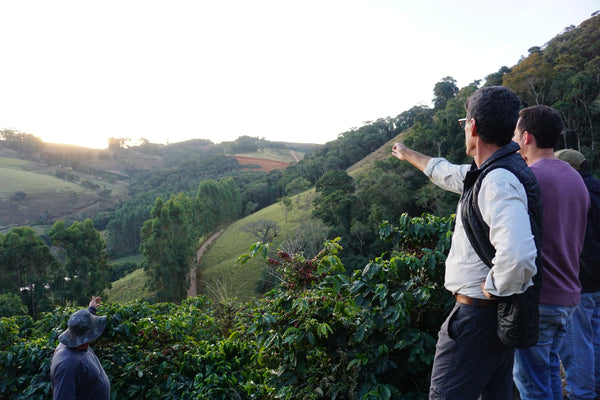
We have worked with Felipe and FAF Coffees every year since we opened our US roastery, and the relationship has only gotten stronger. FAF operates both as a farm and as an exporter supporting other Brazilian producers, which gives Felipe a depth of knowledge across the Mogiana region that consistently shows up in sample quality and lot selection. Four years in, we know what to expect from this table and it has not disappointed.
Country
Coffee arrived in Brazil in 1727, when Francisco de Melo Palheta, a Portuguese military officer sent to arbitrate a border dispute in French Guiana, smuggled coffee seeds back to Brazil, allegedly concealed in a bouquet of flowers by the governor's wife. Those first plants were cultivated in the northern state of Pará, and within a century Brazil had become the dominant force in global coffee production. By 1820 the country was producing 30 percent of the world's supply, and by the early 20th century that figure had climbed to 80 percent. It has remained the world's largest coffee producer ever since.
The scale of Brazilian production is defined by large mechanized estates built for efficiency, but the picture is more nuanced than that framing suggests. About half of Brazil's coffee producers are family-run farms under 10 hectares with minimal mechanization, relying on quality and cooperative representation to access markets. These smaller farms, known locally as sitios, are where much of the country's most interesting specialty work is happening. A growing movement of producers is separating individual farm lots rather than delivering to collectors, and the premiums that follow have created real momentum in the specialty segment.
Brazil is also where much of the coffee world's variety research has originated. Caturra, a dwarf mutation of Bourbon, was first found in Brazil. Mundo Novo, a Bourbon-Typica hybrid and parent of Catuai, was developed by Brazilian agricultural scientists. Catucai and Arara, two of the varieties we are featuring this season, are both Brazilian-bred cultivars developed through programs aimed at improving cup quality alongside disease resistance and yield. That combination of scale, smallholder diversity, and ongoing varietal innovation is why Brazil remains essential on our menu year after year.
(Sources: Sucafina, Cafe Imports, Royal Coffee)
Region – Mogiana
Mogiana is one of the oldest coffee-growing regions in Brazil, with cultivation history dating to the 1800s. The region takes its name from the Companhia Mogiana, the railway company whose lines traversed the mountainous coffee-producing interior of São Paulo state. That railway, known locally as the Coffee Train, was the infrastructure that made early production and exportation viable and shaped the region's identity around coffee from the outset.
The region runs along the border between São Paulo and Minas Gerais, with altitudes ranging from 900 to 1,400 meters above sea level depending on location. Temperatures are mild and consistent, averaging around 20°C, with well-defined wet and dry seasons. Rain falls mostly between October and March, while the dry harvest season runs from April through September, creating conditions that support thorough and even drying. The combination of altitude, stable temperatures, and seasonal rhythm slows cherry maturation and builds the sweetness and balance that Mogiana is known for. Lots from the region regularly exceed 85 points in Brazil Specialty Coffee Association evaluations, and both Catucai and Arara, the varieties grown at Sitio Sassafras and Sitio Siriema respectively, are among the cultivars well established here.
(Sources: Sucafina, Atlantica Coffee, Brazil Specialty Coffee Association)
Farm – Sitio Siriema
Ivan dos Santos was born and raised in Serra do Cigano and has been growing coffee since he was seven years old. He runs Sitio Siriema with his wife Rosimeire, who also produces coffee, and together they have a daughter, Maria Vitória. The farm spans 6 hectares, with 2 hectares dedicated to native forest. Ivan grows Red Catuai, Yellow Catuai, and Red Bourbon across the farm alongside this Arara lot, and plans to introduce more varieties in coming seasons.
Ivan began working in specialty coffee in 2007, which led to his connection with FAF Coffees. For him, coffee is more than a crop. Through his farm and a collective commitment among neighboring producers, he has worked to protect water sources across all local properties. His farm sits at the headwaters of the hill that supplies water to the city of Caconde, and Ivan takes that responsibility seriously. He was the first farmer to have his wastewater treated through FAF Coffees' clean water program, and today more than 30 properties in the area have joined the initiative. For years he has been reducing chemical inputs in favor of biological solutions, rock dust, and other natural alternatives. As he puts it, rich soil means strong plants.
Variety – Arara
Arara is a Brazilian variety and a natural cross between Yellow Catuai and Obatã, where Obatã is itself a Timor Hybrid cross. It produces yellow fruit with large-sized beans and grows on compact trees that make harvesting more manageable. The variety has high resistance to coffee leaf rust, good productivity, and strong cup quality potential, with competition lots reaching into the low 90s since its release. It is a newer variety in the specialty scene but one that has earned attention quickly, combining the agronomic resilience that producers need with the aromatic clarity and sweetness that specialty buyers look for.
(Source: Sucafina, World Coffee Research)
Process – Natural
After harvest, the coffee passes through a dry separator without the use of water. The cherries then rest for approximately 36 hours stored in large bags before drying begins. After this resting period the coffee is transferred to a patio where it dries for around one week, turned three times a day until reaching the half-dry stage. The lot is then moved to mechanical dryers where it remains for approximately 70 hours at 40°C until drying is fully completed.
(Source: FAF Coffees)