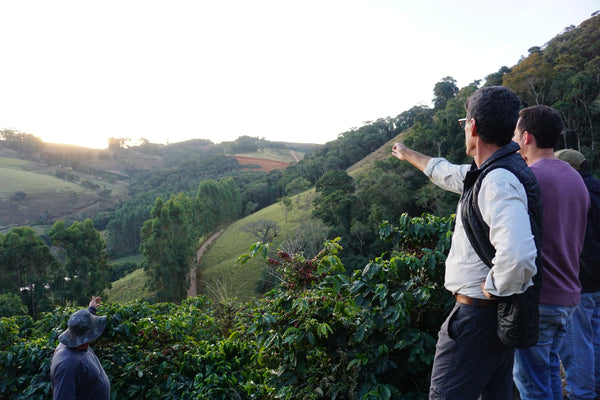
Relationship: This is a coffee we were able to work on with our friends at Balzac Brothers Coffee. Ever since we brought Rwanda - Inzovu, there was a willingness to expand on the relationship and our trust in them led to this coffee. Balzac Brothers are a third generation coffee importer and founded in 1917, they have been importing green coffee for over a 100 years now.
Country: Although production of coffee dates back to the 18th century, it wasn’t until early 20th century that Peru started to export coffee. A mountainous country, farms in Peru are often remote and challenging to get to. Most of the coffee production in Peru is done by smallholder farms and on the eastern slope of the Andes Mountains. As of 2017, coffee was the most valuable agricultural product of the country, now it faces competition from grapes, blueberries and avocados. Another challenge has been transportation of coffee, due to mountainous terrain and lack of advanced infrastructure to farms transportation of coffees has been a challenge. That being said, Peru is the leading producer hor fair trade and organic arabica coffees.
Region: Located in northern Peru, Cajamarca is blessed with moderate climate, fertile soil of the Andes Mountains. Most producers in Cajamarca are, much like the rest of Peru, small producers with average farm size of 2-3 hectares. Much like rest of South American producers, farmers have small pulpers and parabolic dryers. APROCASSI Cooperative works quite closely with San Ignacio, one of the thirteen provinces in Cajamarca.
Processing Station: Aprocassi currently has 600 active members, distributed throughout the provinces of San Ignacio and Jaen in the department of Cajamarca, with crops grown at altitudes ranging from 1,000 to 2,500 meters above sea level. The cooperative also develops social and environmental projects, thus contributing to improving the living conditions of their producers and maintaining environmental sustainability. Aprocassi has many interesting projects and initiatives including empowering women coffee growers to implement beekeeping as a means to diversify their farms and increase yields. They have also piloted a study to analyze the life cycle of their production from farm to port shipment in order to become carbon neutral.
Variety: Being a processing station blend, this coffee consists of the Caturra, Typica, Pache and Bourbon varieties.
Caturra: Discovered in Brazil back in 1915-1918, word Caturra comes from Guarani language, meaning small. Caturra is from Bourbon-Typica lineage, and it was introduced to Guatemala in the 1940s, having never been officially released in Brazil. From Guatemala, it was introduced to Costa Rica, Honduras, and Panama. In Colombia, it became the dominant variety as it was thought to have comprised half of the country's production. Variety’s susceptibility to coffee leaf rust sparked the need for research and paved the way to Castillo variety. Caturra variety has small trees and with average bean size it produces good quality cups at high altitudes.
Typica: One of the main varieties, we owe a lot to this variety. They are low yield, highly susceptible to diseases and require high altitudes to grow. With tall trees, they can’t be densely planted so that also decreases the yield volume. All of these are mitigated by the very high cup quality Typica can produce. In the end it’s all about how good the coffee tastes and Typica is excellent in that regard.
Pache: A natural mutation from Typica, Pache’s mutation resulted in smaller trees compared to Typica. This in turn results in trees being planted more densely and with more trees yield increases. It was first discovered in Guatemala in 1949. Although it is susceptible to diseases, it has good cup value and is optimal for being grown at higher altitudes.
Bourbon:Bourbon varieties are optimal to be grown at higher altitudes with average bean sizes and taller trees. Bourbon varieties tend to produce fuller bodies with sweeter profiles with a bright acidity.
Although their cup quality is usually very good, Bourbon varieties are susceptible to diseases and have lower production volumes compared to some other varieties, another reason we are happy to have this coffee in the roastery. Coffee variety is a discussion that does not take place often and some highly sought after varieties (whether for disease resistance or for higher price points) sometimes come at expense of great varieties like Bourbon group.