Country:
As the world's biggest producer of coffee Brazil’s impact in the industry is undeniable. Whether commercial or specialty, what happens in Brazil affects our industry. That being said, being a volume producer does not exclude Brazil from being able to produce some exceptional coffees. We have worked with Brazil almost every year since we opened and we have always been able to source some interesting single farms that we were quite happy to put on the bar.
Region
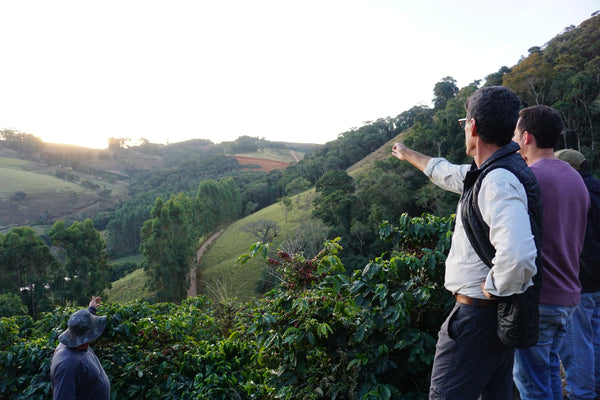
Fazenda Ambiental Fortaleza is located in the Mogiana region, specifically near the city of Mococa in São Paulo state. Situated at elevations between 900 and 1,000 meters above sea level, the farm benefits from a mild climate and well-drained soils, creating ideal conditions for growing specialty coffee with balanced acidity and sweetness. The region’s seasonal rainfall pattern supports healthy cherry development and maturation.
Farm
Fazenda Ambiental Fortaleza has been in the Barretto family since 1850, with a rich history rooted in traditional Brazilian farming. The transformation into a sustainable, organic coffee farm began under Silvia Barretto and her husband Marcos Croce, who envisioned a business model that balances high-quality coffee production with environmental stewardship and social responsibility.
In 2009, their son Felipe Croce joined the farm full-time after gaining experience at a specialty coffee micro-roastery in the U.S. He established an on-site coffee lab and began meticulously sorting and experimenting with varietals and processing methods. Under Felipe’s guidance, the farm has become a pioneering example of regenerative farming practices.
FAF integrates multiple shaded coffee systems, natural forests, and ecological restoration areas into its landscape, creating a mosaic that supports biodiversity—from native bees to threatened species like the maned wolf. The farm employs innovative agroforestry models that focus on nutrient cycling, biomass production, natural pest control, and optimal shade coverage to enhance coffee plant resilience.
Additionally, FAF’s on-farm biofactory produces microorganisms that help combat pests and diseases while promoting soil health and root development. This holistic approach has positioned Fazenda Ambiental Fortaleza as a model organic coffee producer in Brazil, demonstrating that sustainability and quality can thrive hand in hand.
Variety
This lot features the Arara variety, a distinct Brazilian cultivar developed through local breeding programs aimed at improving yield, disease resistance, and cup quality. Arara is known for its adaptability to Brazil’s diverse climates and altitudes, thriving especially well in the Mogiana region’s moderate elevations.
Arara trees typically produce medium-sized cherries with a balanced sugar-acid profile, contributing to the creamy body and smooth texture found in Felipe Croce’s coffees. In the cup, Arara often imparts notes of red apple sweetness, subtle florals, and a pleasant, lingering finish that complements the natural process method used on this lot.
The variety is a product of Brazil’s ongoing efforts in varietal research, combining desirable traits from traditional Arabica cultivars with improvements aimed at disease resilience and environmental adaptability. This makes Arara both a reliable and exciting choice for specialty coffee producers focusing on sustainability and quality.
(Source: World Coffee Research – Arara)
Process:
For this FAF lot, picked cherries begin their post-harvest journey with a careful washing process, where ripe cherries (“cereja”) are separated from floaters (“bóia”). The cherries are then heaped into mounds on a concrete patio and covered, allowing a controlled natural fermentation to develop over approximately 40 hours. During fermentation, the team closely monitors temperature and regularly turns the cherries—mounding and spreading them to ensure an even and consistent process.
Once fermentation is complete, the cherries are spread out under full sun to dry. They are turned hourly over the course of 8 to 12 days, depending on weather conditions like humidity and temperature. When the cherries reach about 15% moisture, they are shaped into a “volcano” pile for an additional 4 to 6 days of drying, reaching the ideal storage moisture level of 11.5%.
After drying, the coffee is stored in traditional wooden-lined silos (tulhas) for at least 30 days before hulling and final processing. This meticulous method preserves the coffee’s natural sweetness, enhances its vibrant fruity notes, and maintains the creamy body that is characteristic of Fazenda Ambiental Fortaleza’s terroir.