Relationship
We’ve worked closely with Falcon Coffee for the last year and a half—mostly on competition-grade selections—and this is our first purchase from Diego Bermúdez’s Finca El Paraíso. Corey, Nathan, and Alejandro helped guide samples and logistics. We cupped 10+ competition lots side-by-side; this coffee tied for first with a Néstor Lasso lot, and we chose to feature a new producer relationship this time. Available through December 31, with best results about three weeks post-roast.
Country
Colombia’s coffee story starts in the 18th century and threads through almost every part of the Andes today. Smallholder families and multigenerational estates tend hillside plots, picking by hand and moving parchment through a well-developed network of buying stations, dry mills, and exporter labs. A long tradition of clean, washed processing underpins Colombia’s reputation for balance and clarity, while the last decade has seen a wave of controlled fermentations, selective inoculations, and temperature-managed drying that has reshaped what Colombian coffee can taste like. For us, Colombia remains essential because it couples complex coffee with elegant acidity and refined sweetness with a culture of innovation that consistently produces competition-level lots like this one.
Region
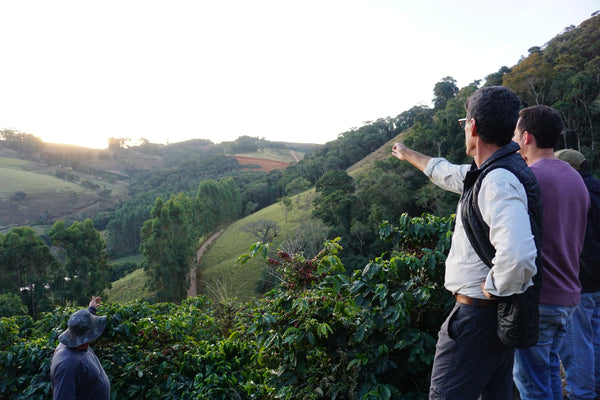
Cauca sits in southwestern Colombia and is home to high, cool Andean terrain with volcanic-derived soils—conditions that slow cherry maturation and help build dense seeds with clear, layered acidity. This Pink Bourbon lot comes from 1,960 m.a.s.l., where moderated daytime temperatures and reliable cloud cover support steady development and sweetness in the cup.
Within Cauca’s quality-focused microlot scene, producers are leaning into controlled fermentations (time/temperature management in sealed tanks, thermal-shock finishes) and careful lot separation to push clarity and aromatic intensity, even as conventional washed processing continues to define most regional output. Finca El Paraíso is a clear example of this direction—its tightly specified, repeatable protocol is part of why this lot reads so perfumed and structured.
Farm
Finca El Paraíso is operated by Diego Bermúdez and family, and it functions as both a working farm and a processing R&D site. Cherries are received with strict ripeness standards, and innovative micro-lots are washed to control the starting microbiology, and tracked through multi-stage fermentations that are measured in hours, not days, with temperature, pH, and pressure logged as they go. Thermal-shock washing—cycling hot water and then cold—has become a signature here, used to arrest fermentation at a precise moment and set aromatic precursors before drying. Drying is just as deliberate: clean, recirculated air, stable temperature and humidity, and a final rest to equalize moisture before milling. Lots are kept separate by variety and protocol, and the farm’s cupping room validates outcomes before export. This highly detailed and careful approach to variety separation and process control create repeatable outcomes and why El Paraíso coffees are highly sought after.
Variety
Despite the name, Pink Bourbon is not simply a pink-skinned mutation of Bourbon; genetic surveys have repeatedly linked it closer to Ethiopian landrace material. In the field it ripens to a salmon-pink cherry, which demands careful selective picking (fully ripe fruit can be mistaken for underripe by color alone). Trees show moderate vigor and require attentive nutrition and rust management, but the cup potential is the draw: high aroma, clear florals (jasmine, violet), and bright citrus-to-tropical acidity when grown high and processed cleanly. Plantings remain limited and are concentrated in southern Colombia—Huila and Cauca especially—so most Pink Bourbon releases are true microlots with strict lot separation. For buyers, it’s a variety that rewards precision at every step; for drinkers, it’s a reliable path to the kind of perfumed, fruit-forward profile that stands out immediately on a cupping table.
Sources:
Café Imports. (2023, September 26). Pink…Bourbon?: Cryptozoology and genetics in specialty coffee.
Process
Cherries are selectively picked (95% fully ripe, 5% slightly underripe) and washed with ozone-rich water to reduce microbial load. Phase 1 is an anaerobic whole-cherry fermentation for 48 hours at 18 °C in sealed tanks with pressure-relief valves. The lot is pulped, then Phase 2 is an anaerobic mucilage fermentation for 48 hours at 18 °C with Lactobacillus added (2 g/kg). The coffee is then washed using thermal shock—first at 45 °C, then at 5 °C— before controlled drying for 28 hours with recirculating air at 40 °C and 25% humidity to 10–11% moisture. After drying, the coffee rests 15 days in GrainPro and is milled with electronic and manual selection prior to export.