

Relationship
We have sourced Maraba Site, Gitega Hills Site, and Gishyita Site from Falcon before, and Rwanda has been one of the more consistent areas of our work together. This season we cupped eight different Nyamasheke lots. Not every cupping session has a clear winner from the first pass, and this was one of the more deliberate ones. Different coffees caught our attention at different stages, some in fragrance, some in aroma, some while the cups were still hot. But when the session was over and we looked at the full picture, Shangi Site was our pick.
Country
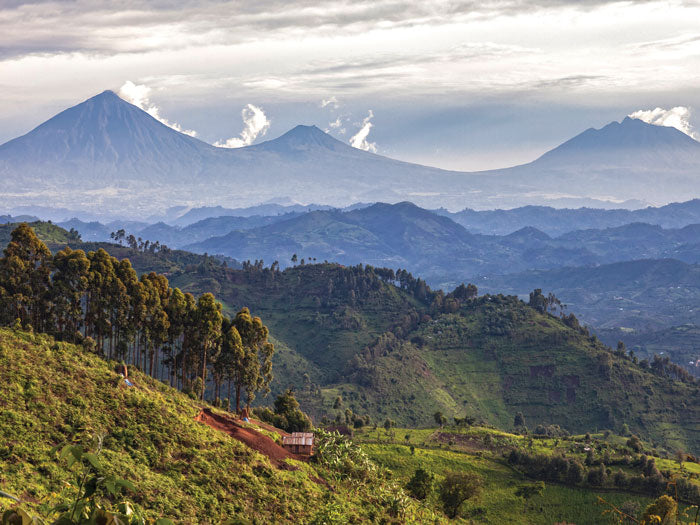
One of the smallest and most densely populated countries in Africa, Rwanda offers ideal conditions for Arabica coffee production with its volcanic rich soils, well-distributed rainfall, and mild temperatures. These factors allow coffee cherries to grow slowly and develop a distinctive intensity in the cup. Coffee is grown along the shores of Lake Kivu and at altitudes from 1,350 to 1,850 meters above sea level. One distinctive element of Rwandan coffees is that soil fertility is maintained through traditional methods, with minimal use of chemical fertilizers and insecticides.
Region
Located south of Lake Kivu and north of Nyungwe Forest National Park, Nyamasheke district sits in southwestern Rwanda, close to the border with the Democratic Republic of Congo. The region benefits from mineral-enriched soils fed by volcanic seepage from Lake Kivu and groundwater flowing from Nyungwe Forest. We consistently find coffees from Nyamasheke to lean sweeter with a syrupy mouthfeel and a clarity that reflects both the altitude and the care taken at the washing stations in the area.
Processing Station
The Shangi Hills washing station is located in Rwanda's Western Province, Nyamasheke District, on the shores of Lake Kivu near the Bweyeye village in the Shangi sector. The station covers 1.3 hectares and sits at just under 1,700 meters above sea level. It was established in 2016 and came under new ownership at the end of 2021, when Fidel, one of the younger operators in the Rwandan specialty sector, acquired it. Fidel started as a trader before building his first washing station, then sold it, acquired Horizon station in 2019, and added Shangi Hills in early 2022. His path into processing reflects a growing generation of Rwandan coffee professionals who have come up through the trade side of the industry and recognized the value of controlling the washed process directly.
The station is managed by Valency Ndacyayisenga, with 2 full-time staff and around 80 seasonal workers during the March to late May harvest. Annually it processes around 600,000 kilograms of cherry from 556 contributing farmers, supported by 14 cherry collection points across the surrounding area. All farmers use organic fertilizer consisting of discarded cherry pulp and manure applied at the base of their trees. Shangi Hills is a newer RTC partner, and this lot is our first time working with the station.
Variety
This lot is Red Bourbon. Bourbon varieties are well suited to higher altitudes, producing fuller bodies, sweeter profiles, and a bright acidity that is immediately recognizable in the cup. Though susceptible to disease and lower-yielding than many modern hybrids, Bourbon remains one of the most prized varieties in East African specialty coffee for the complexity and sweetness it delivers when grown and processed carefully.
Process
Ripe cherries are selectively hand-sorted and delivered to the station, where they are depulped and fermented in tanks to break down the mucilage. Following fermentation, the parchment is washed thoroughly, graded in channels by density, and transferred to raised drying beds. Drying is carried out slowly under sun and shade, with careful turning throughout to ensure even moisture loss. The fully washed approach emphasizes the clarity and structure that define the best Nyamasheke lots, and the result is the clean, tea-like body and bright fruit character we found in Lot 784 on the cupping table.