

Relationship:
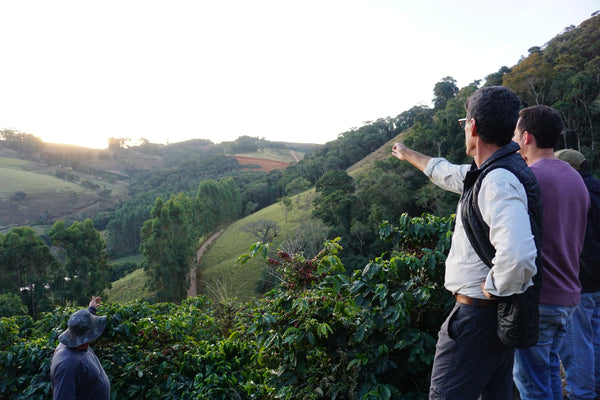
Our relationship with Falcon Coffee has become one of our most consistent sourcing partnerships since we first worked together in late 2024. Corey, Nathan, and Alejandra have been central to how we approach sample selection, and this purchase is another example of that collaboration extending in a new direction. It was Corey and Brian from Falcon who made the introduction to Siruma Coffee, bringing their team to our Arts District shop after SCA World Expo in San Diego. That visit was less about cupping and more about understanding how we could work together around competition season, and this Gesha lot is the first result of that conversation.
Siruma is a Colombian exporter built around the idea that specialty coffee should create lasting value at origin. They work closely with producers across Colombia, supporting better farming practices and stronger community relationships, and their work is complemented by the Apuna Foundation, through which they support social development and gender equity in coffee-growing communities. Working with Siruma through Falcon gives us access to a deeper pool of Colombian lots than a single importer relationship would allow, and the logistics remain in Falcon's hands.
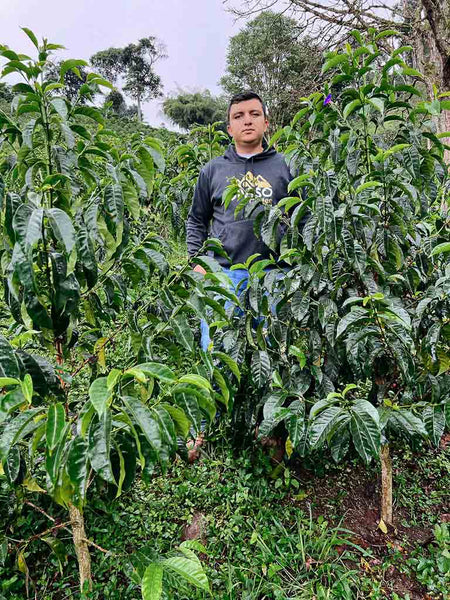
This is our third purchase from Nestor Lasso's Finca El Diviso, and each lot has pushed in a different direction. The Gesha is the most delicate and aromatic of what we have worked with from this farm.
Country:
One of the best known countries in the specialty coffee scene, Colombian coffees have carved a special place for themselves in the market and definitely here at Boxx. It is an origin dear to our hearts here and one that we try to showcase constantly in different offerings. It was first introduced to the country in the early 17th century by Jesuit settlers and quickly grew popular and more “finca”s started to grow coffee over time. Today, Colombia stands as one of the more famous countries in the specialty coffee scene and is one of the pioneers in different processing methods.
Region- Huila / Pitalito:
Finca El Diviso sits in Pitalito, in the upper Magdalena River valley in southern Huila, at the foot of the Andes. Huila is consistently among Colombia's top-producing departments, and the valley's airflow and buffered temperatures promote slow cherry maturation, which helps build dense sugars and translate into cups with sweet structure and bright acidity. This Gesha lot comes from 1,750 to 1,900 meters above sea level, where cooler temperatures slow development further and the variety's aromatic potential is most fully expressed.
Farm – Finca El Diviso:
Finca El Diviso is operated by Nestor Lasso and has become one of the most recognized farms in the specialty coffee industry. The farm covers 18 hectares, with 15 under coffee and 2 dedicated to native forest, and 80,000 trees across the property. Nestor has built Finca El Diviso into both a working farm and a processing research site, cultivating an extraordinary range of varieties including Caturra, Castillo, Tabi, Pink Bourbon, Red Bourbon, Yellow Bourbon, Bourbon Ají, Caturra Chiroso, Geisha, Sidra, Java, and Pacamara. That diversity is not incidental; it reflects a deliberate approach to understanding how variety, process, and altitude interact at this specific site. The farm has appeared regularly at Cup of Excellence Colombia and has been one of the pioneers of alternative processing techniques in the country. Nestor and his brother Adrian run the operation together alongside partner Johan Vergara.
One of the most acclaimed farms in the coffee industry, Nestor Lasso’s Finca El Diviso has been featured regularly on Cup of Excellence Colombia and has been one of the pioneers when it comes to alternative processing techniques. Nestor and his brother Adrian have taken over their farm Finca El Diviso from their family and after partnering up with Johan Vergara they started making some waves in the specialty coffee industry.
Variety – Gesha
Gesha (also spelled Geisha) traces its origins to the Gori Gesha forest in southwestern Ethiopia, where it was collected in the 1930s and eventually made its way through research stations in Tanzania, Costa Rica, and Panama before arriving in Latin America. It remained relatively obscure until 2004, when a lot from Hacienda La Esmeralda in Panama scored an unprecedented 95 points at the Best of Panama competition and sold at auction for a record price, rewriting what the market understood specialty coffee could be.
The variety is tall and willowy with elongated beans and a distinctive drooping branch structure. It is low-yielding, susceptible to disease, and demands high altitudes and meticulous processing to express its potential. The payoff, when conditions align, is a cup with extraordinary aromatic complexity: jasmine, bergamot, tropical fruit, and a tea-like clarity that is immediately recognizable. At 1,750 to 1,900 meters in Pitalito with Nestor's precision processing behind it, this lot is a strong expression of what Gesha can be outside of its more established Panama context.
(Source: World Coffee Research)
Process – Mosto Anaerobic Natural
Cherries are picked carefully for full ripeness and sorted through disinfection and flotation to remove impurities and less dense beans, followed by manual sorting to select only ripe fruit. The cherry then undergoes a 48-hour oxidation phase in plastic tanks. From there it moves into anaerobic fermentation in sealed plastic bags or tanks for 32 hours at 17 to 20 degrees Celsius. At this stage, leachate collected from the cherry during fermentation is stored and set aside for reuse in subsequent lots, a practice central to the Mosto process at El Diviso. Cherry mosto from a previously processed lot is then introduced, and a submerged fermentation takes place at 17 to 23 degrees Celsius for 12 hours with continuous leachate recirculation. To complete fermentation, a thermal shock is performed at 65 to 70 degrees Celsius.
Drying begins in stainless steel dehumidifiers, which allow precise control over moisture loss in a dark, airtight environment. This approach limits terpene volatilization and protects the aromatic compounds characteristic of the Gesha variety from external contamination. Maximum drying temperatures do not exceed 37 degrees Celsius until a moisture content of 10 to 11 percent is achieved. The coffee is then stored in GrainPro bags to preserve aromatics through to milling.
(Source: Finca El Diviso producer notes)