

Relationship
This coffee comes through Moii Coffee, an importing company led by Firaol, and marks our first time working with them. As we said in the intro, this introduction happened in the shop but a bit out of the blue. Travis has wanted to work with Alo Coffees for his Brewer’s Cup routines for a while and last year we were able to source one through Falcon. A couple days after SCA, as we were working in the shop while I was on my lunch break, I got a call from Travis Tulu, Firaol and Tamiru were at the shop. He recognized Tamiru so after he called me I got back to the shop and we had a nice chat with them for an hour or so. Firaol is Ethiopian and Moii Coffee’s proximity to producers in Ethiopia means we can access lots that fall outside the catalog of larger import relationships, and this Adorsi washed is an early example of what that access can produce.
Country
Ethiopia is the birthplace of Arabica and Africa’s largest coffee producer. Coffee accounts for 30 to 35 percent of the country’s total export earnings and the livelihoods of roughly 25 percent of the population are directly or indirectly tied to the coffee value chain. Most production comes from smallholder families working plots of a few hectares, picking ripe cherry by hand and delivering it to local washing stations where lot separation and meticulous processing shape flavor. High domestic consumption, driven by a deep-rooted coffee culture that predates commercial export by centuries, keeps roughly half of every harvest in-country. Exported lots like this one represent the portion of Ethiopian production that reaches the international market, and traceable, station-level coffees remain a small share of that.
(Source: USDA FAS Coffee Annual)
Region - Yirgacheffe
Yirgacheffe is a woreda within the Gedeo Zone of southern Ethiopia, and the name that has defined washed Ethiopian coffee for decades. Royal Coffee describes the Gedeo Zone as a narrow section of highland plateau dense with farmers and fiercely competitive processors, and Yirgacheffe was one of the first areas in Ethiopia to fully wash its coffee. That tradition of meticulous wet processing is a meaningful part of why the region’s washed lots carry the clarity and aromatic precision.
Aricha is a kebele within Yirgacheffe, sitting at 1,950 to 2,150 meters above sea level. The area is known for clay soils, well-distributed rainfall, and a misty highland microclimate that moderates temperature and slows cherry development. Coffee here grows under indigenous shade trees intercropped with food crops in the traditional smallholder garden system common across the Gedeo Zone. Farming practices remain largely organic by default, with minimal use of fertilizers or pesticides. Washed coffees from Aricha are known for their lemon and citrus brightness, stone fruit sweetness, and the tea-like body that defines the best of what this part of Yirgacheffe produces.
(Sources: Sucafina, Royal Coffee, producer notes)
Processing Station - Adorsi
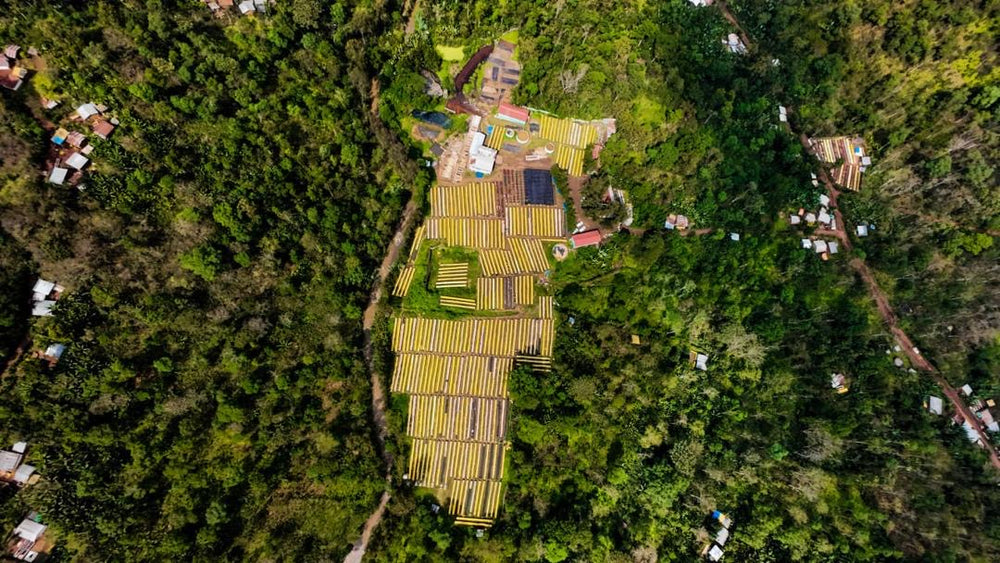
Faysal Abdosh purchased the Adorsi washing station in 2018 and has built it into a reliable source of quality washed Yirgacheffe lots. The station draws cherry from over 800 contributing farmers across the surrounding area, and its position in Aricha places it squarely in one of the Gedeo Zone’s most competitive processing environments. Cherries are sorted on arrival to separate floaters, then depulped and fermented for 24 hours in temperature-controlled water sourced from the Wogida river. After fermentation the parchment is spread in a single layer on raised drying beds and dried for approximately 15 days, with frequent turning throughout to prevent mold and ensure even moisture loss.
(Sources: Moii Coffee, producer notes)
Variety - Kurume / 74110 / 74112
This lot consists of Kurume, 74110, and 74112, three varieties that frequently appear together in Yirgacheffe and the broader Gedeo Zone and share meaningful agronomic similarities.
Kurume is a regional landrace traditionally selected by farmers in the Gedeo Zone and Guji, identified by the Jimma Agricultural Research Center for its strong yield and adaptability. It is not a bred variety but one that emerged from generations of selection within the landscape it grows in. Trees are compact with small cherries, and the variety is considered representative of Yirgacheffe’s native genetic material.
74110 and 74112 are JARC selections released in 1979, developed from wild populations collected in 1974 for their resistance to Coffee Berry Disease. Both share the compact stature and small cherry size characteristic of Kurume, reflecting how closely related these varieties are in the context of this specific terroir. Together the three form a lot that is deeply rooted in the genetic identity of the Gedeo Zone.
(Sources: Royal Coffee, Sucafina, Jimma Agricultural Research Center)
Process - Washed
Ripe cherries are sorted on arrival, with floaters removed before processing begins. The coffee is depulped and fermented for 24 hours in temperature-controlled water from the Wogida river, a controlled environment that supports clean, even fermentation. After fermentation the parchment is spread in a single layer on raised African drying beds, where it dries for approximately 15 days with frequent turning to prevent mold and ensure consistent moisture loss. The result is the clean, tea-like clarity and citrus brightness we found on the cupping table.
(Source: Moii Coffee, producer notes)