

Relationship
Primavera Green Coffee has been our Guatemala partner for nine years, and this is the first time we are sourcing an Ethiopian coffee through them. Primavera started building relationships in Ethiopia two years ago. We cupped it as part of a tasting of their new season African coffee options. We really enjoyed finding a classical washed Ethiopian in the selection.
Country - Ethiopia
Ethiopia is the birthplace of coffee and still Africa's largest coffee producer. Coffee accounts for 30 to 35 percent of the country's total export earnings and the livelihoods of roughly 25 percent of the population are directly or indirectly tied to the coffee value chain. Most production comes from smallholder families working plots of a few hectares, picking ripe cherry by hand and delivering it to local washing stations where lot separation and meticulous processing shape flavor. High domestic consumption, driven by a deep-rooted coffee culture that predates commercial export by centuries, keeps roughly half of every harvest in-country. Exported lots like this one represent the portion of Ethiopian production that reaches the international market, and traceable, station-level coffees remain a small share of that.
(Source: USDA FAS Coffee Annual)
Region - Yirgacheffe / Gerse
Yirgacheffe is a woreda within the Gedeo Zone of southern Ethiopia. Gedeo Zone is a narrow section of highland plateau dense with savvy farmers and fiercely competitive processors, and Yirgacheffe was one of the first areas in Ethiopia to fully wash its coffee. What we are looking for in washed coffees from Eastern Africa is medium plus acidity, high clarity and when it comes to Ethiopia peach/apricot notes.
Gerse is a kebele within Yirgacheffe, sitting at 2,000 to 2,200 meters above sea level on clay soils with 1,500 millimeters of annual rainfall. Coffee here grows under indigenous shade trees including Wanza, Girar, and Weyira, intercropped with food crops in the traditional smallholder garden system common across the Gedeo Zone. Farming practices remain largely organic by default, with minimal use of fertilizers or pesticides and almost all work done by hand. Washed Yirgacheffe coffees from this environment are known for their floral aromatics, lemon and citrus brightness, stone fruit sweetness, and a tea-like clarity in the body that is immediately recognizable as one of the most distinctive profiles in specialty coffee.
(Sources: Sucafina, Royal Coffee, producer notes)
Processing Station - Gerse
Mikiyas Bogale inherited a washing station in the Gerse Kebele from his father, Bogale Mengistu, in 2020. Bogale Mengistu founded the family's coffee operation in 1991, building a long track record in Yirgacheffe production that included supplying exporters and the Ethiopian Commodity Exchange. Mikiyas lived in Germany for a period before returning in 2018 to build on that foundation, establishing Fair Specialty Coffee Export as a modern export company rooted in the family's history. The washing station works with smallholder producers across the Gerse area and produces approximately 300 bags per year, a deliberately small volume that reflects the tight geographic focus and the hand-level attention the station applies to cherry selection and processing.
(Sources: Fair Specialty Coffee, Primavera Green Coffee producer notes)
Variety
In Yirgacheffe, as across most of Ethiopia, farmers cultivate locally adapted landraces alongside JARC selections, with most plots containing a mix of both that has developed over generations of seed sharing and garden interplanting. These cultivars are not formally traceable to a single variety on most station-level lots. The genetic diversity they represent is a core reason why Yirgacheffe coffees, and washed Ethiopian coffees in general, carry the aromatic complexity and floral intensity that defines the style.
(Source: Sucafina)
Process - Washed
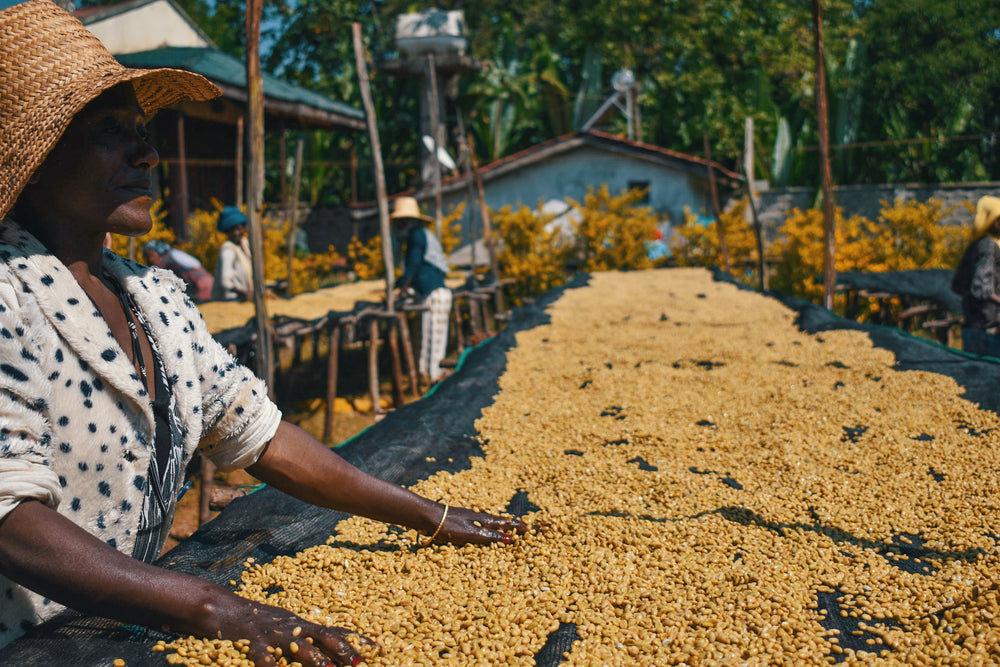
Ripe cherries are harvested and purchased from smallholder producers in the Gerse area. After a presort, the coffee is pulped using a local Agard pulping machine, then density sorted by flotation before fermenting in large concrete tanks for 48 to 72 hours depending on weather conditions. The coffee is washed in channels before being moved to raised African drying beds, where it is further hand sorted for defects throughout the drying period. After checking moisture and completing final defect sorting, the coffee is stored in parchment onsite before being transported to Addis Ababa.
(Source: Primavera Green Coffee producer notes)