

Relationship
This coffee comes through Balzac Brothers, a third generation coffee importer founded in 1917 that has been importing green coffee for over 100 years. It is our first Ethiopian coffee from Balzac. Angela is our first point of contact at Balzac. She and Nathan both helped us pick samples and get them to us. The Balzac team is great to work with.
Country
Ethiopia is the birthplace of coffee and still Africa's largest coffee producer. Coffee accounts for 30 to 35 percent of the country's total export earnings and the livelihoods of roughly 25 percent of the population are directly or indirectly tied to the coffee value chain. Most production comes from smallholder families working plots of a few hectares, picking ripe cherry by hand and delivering it to local washing stations where lot separation and meticulous processing shape flavor. High domestic consumption, driven by a deep-rooted coffee culture that predates commercial export by centuries, keeps roughly half of every harvest in-country. Exported lots like this one represent the portion of Ethiopian production that reaches the international market, and traceable, station-level coffees remain a small share of that.
Region - Gedeb
Worka Sakaro Washing Station is located in the Worka Chelbesa kebele of Gedeb, part of the Gedeo Zone of southern Ethiopia. Across the zone, coffee and enset are the main crops, and a 2025 study of the zone's coffee production environments records altitudes from about 1,477 to 3,071 meters. Importer Ally Coffee describes the landscape around Worka Chelbesa as dense semi-forest vegetation, including ensete trees and other shade plants.
Sources: Balzac Brothers; Getahun et al. 2025, Beverage Plant Research; Ally Coffee
Washing Station – Worka Sakaro
Worka Sakaro Washing Station works with over 400 smallholder farmers. Balzac Brothers reports that these farmers grow their coffee on steep mountain slopes at approximately 2,000 to 2,200 meters above sea level, in the shade of Birbira, Cordia africana, and Ensete ventricosum trees. The coffee is picked when the cherries are ripe and dried on raised beds. Once dried, it is milled to remove the husks and stored in a local warehouse before being transported for final processing before shipment.
Source: Balzac Brothers
Variety - Kurime / Dega / Wolisho
This lot consists of the indigenous heirloom cultivars Kurime, Dega, and Wolisho.
Kurime is a regional landrace traditionally selected by farmers in the Gedeo Zone and Guji, identified by the Jimma Agricultural Research Center for its strong yield and adaptability. It is not a bred variety but one that emerged from generations of selection within the landscape it grows in. Trees are compact with small cherries, and the variety is considered representative of Yirgacheffe's native genetic material.
Dega and Wolisho are landraces grown by local farmers around Worka Chelbesa, according to Ally Coffee. A 2025 study of the Gedeo Zone describes Wolisho as a cultivar with large cherries and long leaves, and Dega (spelled Diga there) as a landrace suited to cool highland areas.
Sources: Sucafina; Getahun et al. 2025; Ally Coffee
Process - Anaerobic Natural
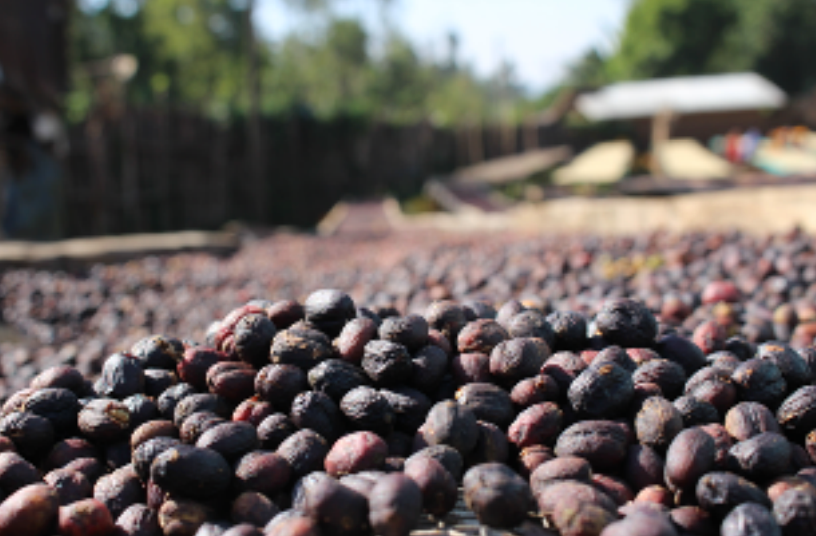
This lot follows the wave of groups now experimenting with anaerobic processing. It follows all the same steps as a typical naturally processed coffee, except that after the coffee is floated, it is placed into special plastic bags, flushed with carbon dioxide and nitrogen gas, and monitored over 3 to 7 days until fermented adequately, which varies with mucilage content and environmental conditions. Once the cherries reach the desired pH and color, they are removed from the bags and transferred to drying tables to complete the process. The coffee is dried on raised beds for 18 days, on 80 raised beds.
Source: Balzac Brothers