

Relationship
This coffee comes through Balzac Brothers, a third generation coffee importer founded in 1917 that has been importing green coffee for over 100 years. Angela is our first point of contact at Balzac. She and Nathan both helped us pick samples and get them to us. The Balzac team is great to work with.
Country
Coffee was introduced to Kenya in the late 19th century, but it was not until the 1930s that the country developed its now-renowned auction system and wet mill model. These systems helped create one of the most transparent and quality-focused supply chains in the world, with an emphasis on meticulous washed processing and centralized quality control. Kenya's coffees became known for their blackcurrant notes, vibrant acidity, and structured profiles, attributes that continue to define its top lots today.
Today, specialty coffee remains a crucial economic contributor for Kenya. The sector relies heavily on smallholder farmers, and roughly 80% of Kenya's coffee is marketed through producer cooperatives, which deliver cherry to centralized factories (wet mills). These growers play an essential role not only in sustaining quality but also in preserving the traditional double fermentation and slow drying methods that make Kenyan coffees unique.
The country's coffee thrives in fertile, iron-rich volcanic soils, especially in central and eastern regions near the slopes of Mount Kenya. These soils, combined with moderate rainfall and high elevation, contribute to slow cherry maturation, resulting in dense, complex beans with bright acidity and clean finishes.
Source: USDA FAS, Kenya Coffee Annual (2026)
Region - Nyeri
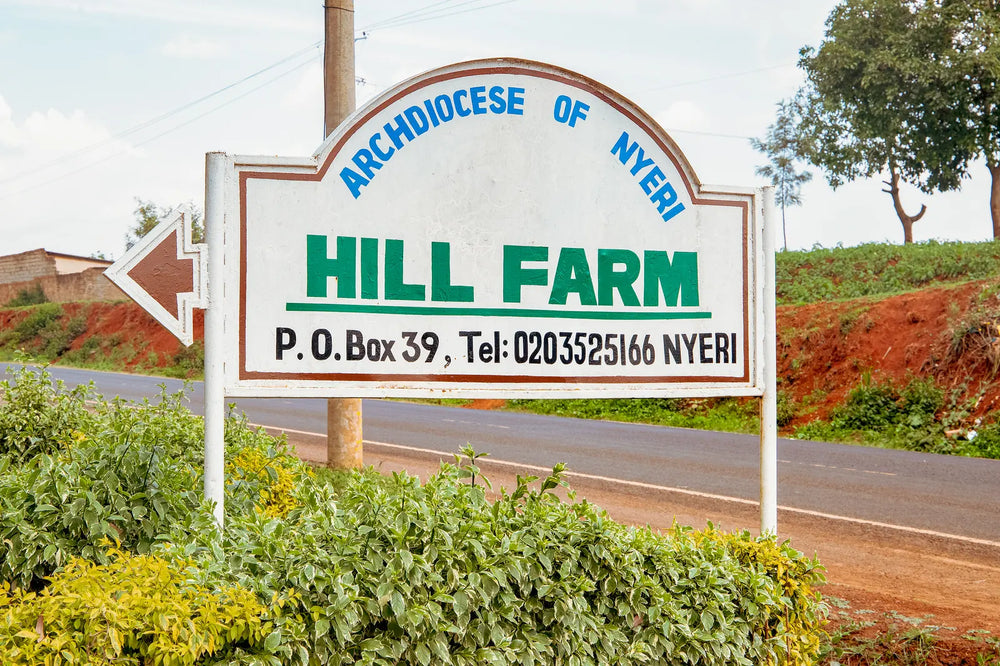
Nyeri Hill Estate sits two kilometers northwest of the town of Nyeri, along the Nyeri-Ihururu road, on the slopes of Kenya's central highlands. Its coffee grows between 1,800 and 2,200 meters above sea level.
Sources: Balzac Brothers; Mercanta
Farm - Nyeri Hill Estate
Balzac Brothers describes Nyeri Hill Estate as one of the first coffee farms established in eastern Africa, with its first coffee seedling planted in 1914. The estate covers 1,415 hectares, 344 of which are devoted to coffee, and employs 300 people. It is Rainforest Alliance certified. Balzac reports that the estate allocates part of its profits to Nyeri High School, Kamwenja Teachers College, and Mathari Mission Hospital, and that it focuses on reforestation across 250 hectares, preserves natural vegetation to encourage biodiversity, and uses Bermuda grass cultivation for soil retention.
Source: Balzac Brothers
Variety - SL28 / SL34 / Ruiru 11
This lot consists of SL28, SL34, and Ruiru 11, three cornerstone cultivars in Kenya's coffee landscape. Balzac Brothers notes that Ruiru 11 makes up over 18 percent of the estate's total production.
SL28: SL28 was selected in the 1930s by Scott Agricultural Laboratories for its exceptional drought resistance and cup quality. It is known for producing coffees with bright, wine-like acidity, layered sweetness, and notable clarity. SL28's genetic lineage traces back to the Bourbon-Typica group, and it remains one of the most prized varieties in East African specialty coffee.
SL34: Another selection from Scott Labs, was developed from French Mission Bourbon and is well-suited to high elevations with good rainfall. It produces excellent cup profiles, often with a bit more body than SL28, though it is more susceptible to disease. Together, SL28 and SL34 form the traditional backbone of many of Kenya's top lots.
Ruiru 11: Ruiru 11 was released in 1985 by Kenya's Coffee Research Foundation in response to widespread disease pressure. It is a compact, high-yielding hybrid that combines the cup traits of SL28 with the disease resistance of Catimor. While Ruiru 11 has historically received a mixed reception for cup quality, careful separation and processing can result in expressive, fruit-forward coffees.
Sources: World Coffee Research; Balzac Brothers
Process - Fully Washed
Nyeri Hill Estate's coffee is processed using the fully washed method. Ripe cherries are handpicked by the estate's team. The seeds are then extracted from the cherries, fermented, and washed, and the coffee is dried in natural sunlight. Grades AA, AB, and PB make up over 80 percent of the estate's coffee. This is what we expect from a washed Kenyan coffee.