

Relationship
This coffee comes through Balzac Brothers, a third generation coffee importer founded in 1917 that has been importing green coffee for over 100 years. Angela is our first point of contact at Balzac. She and Nathan both helped us pick samples and get them to us. The Balzac team is great to work with.
Country
One of the smallest and most densely populated countries in Africa, Rwanda offers ideal conditions for Arabica coffee production with its volcanic rich soils, well-distributed rainfall, and mild temperatures. These factors allow coffee cherries to grow slowly and develop a distinctive intensity in the cup. German missionaries brought coffee to Rwanda in the early 1900s, and today 355,771 farmers grow it, with more than 300 washing stations processing it. Bourbon makes up about 95 percent of Rwanda's coffee trees, and the harvest runs from March to June. Coffee is grown along the shores of Lake Kivu and at altitudes from 1,400 to 1,900 meters above sea level. One distinctive element of Rwandan coffees is that soil fertility is maintained through traditional methods, with minimal use of chemical fertilizers and insecticides.
Sources: Sucafina; NAEB; Balzac Brothers
Region - Nyamasheke
Located south of Lake Kivu and north of Nyungwe Forest National Park, Nyamasheke district sits in southwestern Rwanda, close to the border with the Democratic Republic of Congo. The region benefits from mineral-enriched soils fed by volcanic seepage from Lake Kivu and groundwater flowing from Nyungwe Forest. We consistently find coffees from Nyamasheke to lean sweeter with a syrupy mouthfeel and a clarity that reflects both the altitude and the care taken at the washing stations in the area.
Washing Station - Inzovu
Inzovu is an annual offering from Rwanda Trading Company (RTC), a community coffee drawn from 65 washing stations and more than 80,000 farmers across Rwanda. Balzac Brothers describes it as an example of RTC's ability to provide a consistent profile from year to year. RTC was established in 2009, owns and operates sixteen wet milling stations, and works directly with farmers, buying, milling, processing, and marketing their coffees while investing in agribusiness training programs. Balzac reports that since 2013 these programs have resulted in an 86 percent increase in farm revenue for RTC's producer-partners.
Source: Balzac Brothers
Variety - Bourbon / Typica
This lot consists of Bourbon and Typica.
Bourbon is a classic heirloom variety with a storied history across Latin America. Known for its fuller body and complex sweetness, it adds depth and richness to the cup, typically contributing vibrant fruit flavors, balanced acidity, and a smooth finish.
Typica is one of the foundational Arabica varieties and the ancestor of many cultivars grown around the world today. Trees are tall, low-yielding, and susceptible to disease, but the cup quality they produce is exceptional: clean, refined, and capable of great clarity and sweetness at high altitudes.
Process - Fully Washed
Rwandan washed coffee is processed at washing stations. Before the first stations opened, farmers processed cherry at home, producing semi-washed coffee of lower quality. Today more than 300 stations operate across the country, and 62 percent of Rwandan coffee is exported fully washed.
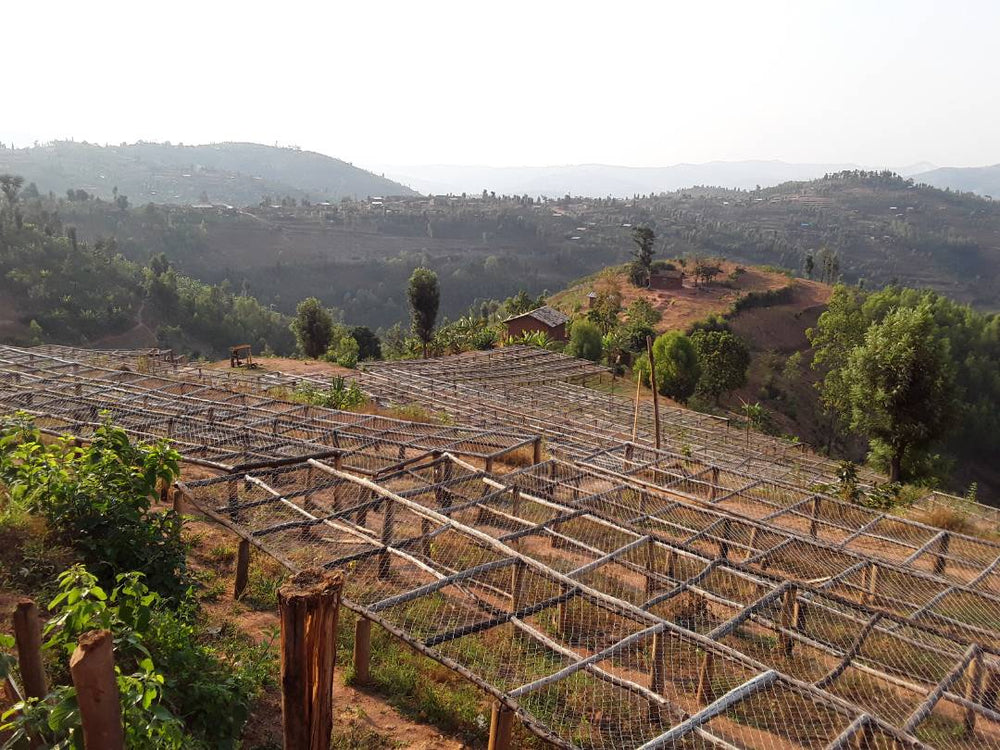
At a washing station, ripe cherries are hand-sorted on delivery and depulped. The coffee is then fermented in tanks to break down the mucilage, washed thoroughly, and graded in channels by density. The parchment is dried on raised beds, slowly under sun and shade and turned regularly to ensure even moisture loss.
Sources: Sucafina; NAEB